Fractals
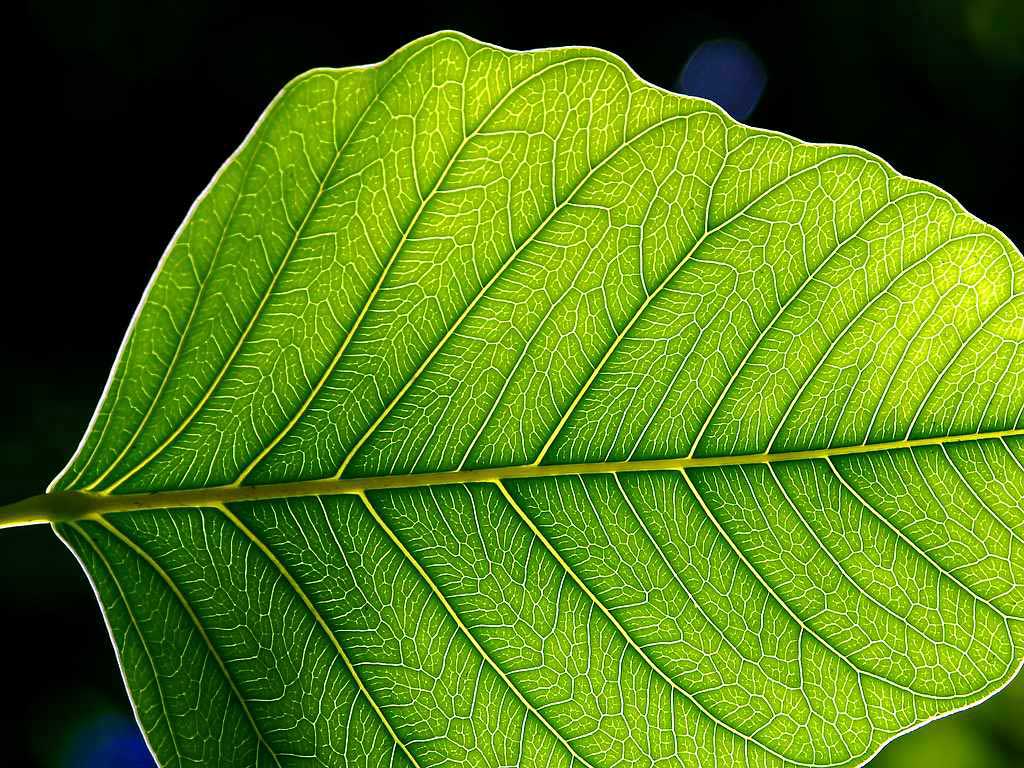
Question: What do a leaf, a lung, and language all have in common?
What's a Fractal?
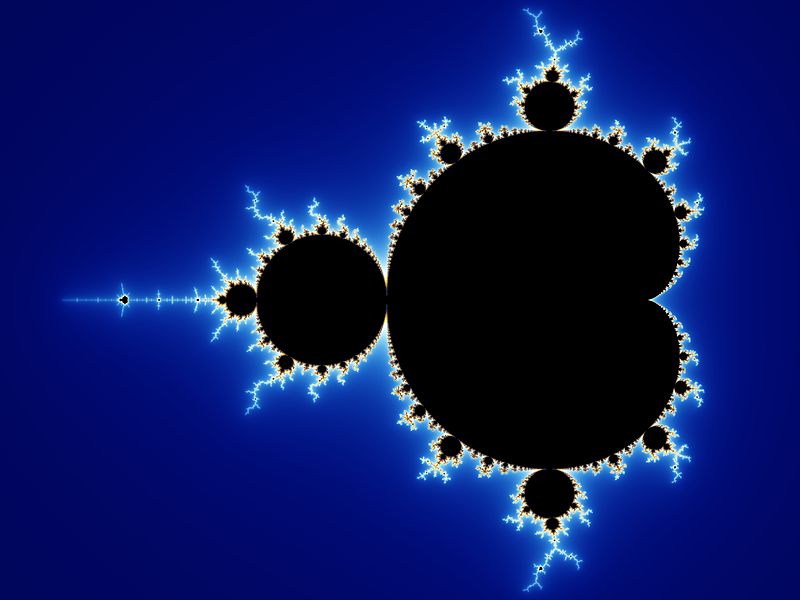
You might have heard the world "fractal" before. You may have even seen some pictures or youtube videos of them. But what are they?
Fractals are a special kind of shape. What makes them special is the fact that they exhibit "self-similarity", which means that they repeat themselves (often to infinity). Put another way, a fractal looks more-or-less the same no matter how much you zoom in or zoom out of it.
Fractals are often self-generating according to a simple rule. Look at the triangles below for example. You start with a triangle and the one rule: every time you see a triangle, remove a triangle-shaped piece from the middle of that triangle. If you apply that rule again and again to every new image you get a famous fractal known as the Sierpinski Triangle.

Notice how each new image contains a copy of the previous image in it. The second image is made up of copies of the solid triangle, the third image is made up of copies of the second image, and so on for forever. This is the self-similarity I mentioned above. Each image builds off of, and resembles the one before it.
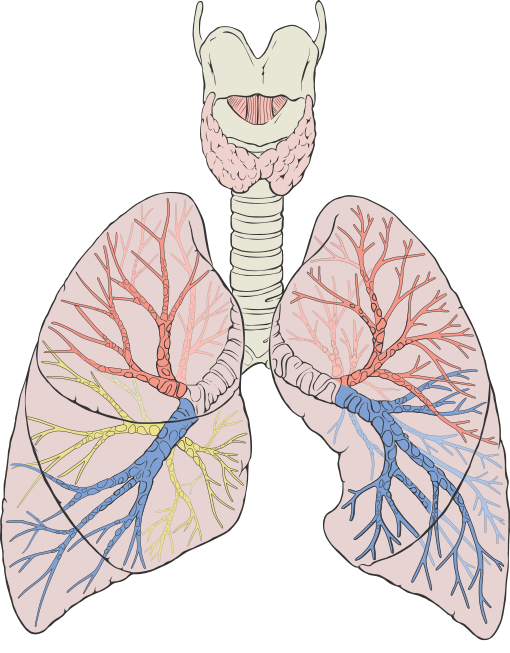
So what do a leaf, a lung, and language all have in common? They can all be considered self-similar. The leaf and lung you can see easily enough for yourself. They have a branching tree-like structure to them. (Interestingly, so does your circulatory system). But language is a little more abstract. The argument involves the fact that you can use the rules of language to make a sentence as big as you could ever want. For example, start with the root sentence: The fat cat ate. Then you can tack on "Jimmy saw" and make a bigger sentence: Jimmy saw the fat cat eat. And you could go on as long as you wanted... Sally saw Jimmy see the fat cat eat, Billy said he saw Sally see Jimmy see the fat cat eat, . . .
Recursion and Fibonacci
This ability to self-reference, to somehow pass on information from one step to the next is also known as recursion. Fractals are recursive since they have the property of being self-referencing. Often (but not always) "recursive" and "self-similar" are interchangeable.
One of the most well-known examples of recursion is the Fibonacci sequence. The Fibonacci numbers are defined like this:
$$ F_{n}=F_{n-1}+F_{n-2} $$
where \(F_{n} \) is the nth number in the sequence. By definition the next number in this sequence of numbers depends on the two immediately previous numbers. That's why it's recursive: it references its own sequence of numbers to generate the next number in that sequence. So \(F_{4} = F_{3}+F_{2} \) and \(F_{150}=F_{149}+F_{148} \). Because the Fibonacci numbers need at least two numbers to start, we just define the first two numbers to equal one. That is: \(F_{0}=F_{1}=1 \). (Notice I started counting at 0).
That makes the first few numbers in the Fibonacci sequence:
$$ F_{0} = 1 $$ $$ F_{1} = 1 $$ $$ F_{2}=F_{1}+F_{0} =1+1 = 2 $$ $$ F_{3}=F_{2}+F_{1} = 2+1= 3 $$ $$ F_{4}=F_{3}+F_{2} = 3+2 = 5 $$ $$ F_{5}=F_{4}+F_{3} = 5+3=8 $$ $$ F_{6}=F_{5}+F_{4} = 8+5=13 $$
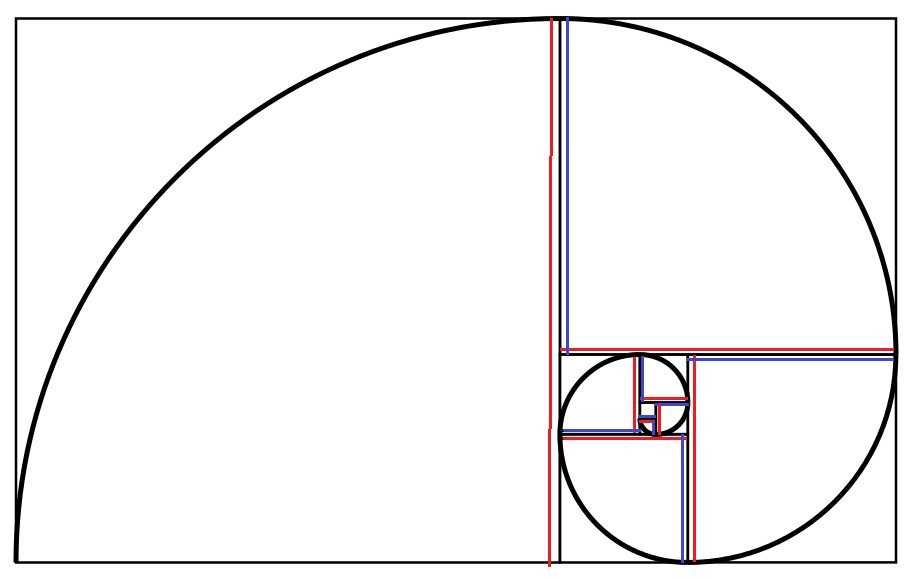
The picture to the right is one way of visualizing this. The center two boxes have side-length 1, and all other boxs' side-lengths are the corresponding Fibonacci number. The spiral is made by rotating 90 degrees and drawing a quarter-circle with radius of the current length. The ratio of red length / blue length represents the ratio of consecutive Fibonacci numbers ( \(F_{1}/F_{0} , F_{2} /F_{1} , ... , F_{n}/F_{n-1} , ...\) ) . This ratio is approximately the Golden Ratio, φ (the Greek letter "phi") and has a value of roughly 1.618033.... In fact, the higher you go in the Fibonacci sequence the closer and closer that ratio gets to exactly equalling φ.
Fractals and Nature
There's no such thing as a "true" fractal in the real world. Unlike in the purely mathematical fractals we've already seen, there's no such thing as Infinity in nature. Which means any "true" fractals in the real world couldn't go outward (or inward) forever. And also unlike pure math, and for the same reason, "real" space in nature cannot be infinitely divided. You can only cut something so thin until you get down to atoms.
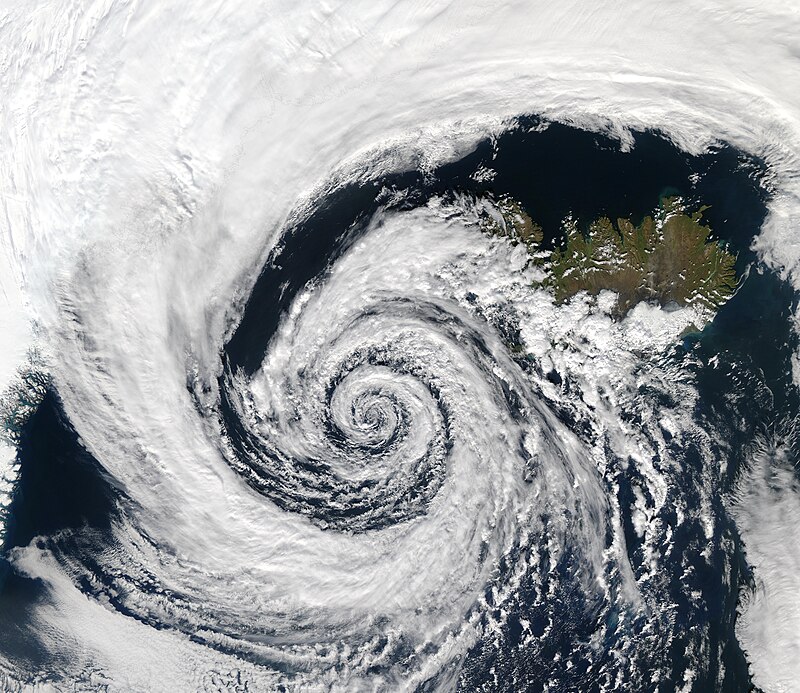
But that said, things that look and act very, very similarly do exist in real life, and you've seen them before. If you've ever held two mirrors together, or looked at a tree, you've seen a "natural" fractal. The spiral of the nautilus shell to the right, and the shape of some weather systems are more examples of fractals in nature. Compare that shell to the Fibonacci spiral above it. You can measure the growth rate of siprals. It's no surprise that the growth rate of the Fibonacci spiral is φ (≈1.618). And the nautilus's is ≈1.76. (How many more spirals in nature can you think of?) Trees are another common fractal shape in nature. They look like actual trees of course. And as we've also seen the blood flow/air flow networks in human (and other) bodies is tree-like. Though not certain, scientists suspect that this is because it is the most efficient way to store this information in the DNA. It would be too costly to have a tiny piece of DNA for every single artery, vein, alveoli, etc in a body.