About Physics
What is physics?
In one sentence: Physics is the scientific study of the fundamental aspects of the universe.
The goal of physics is to understand what the fundamental building blocks of nature are and the principles by which they interact. So far as we can tell, the fundamental building blocks seem to be tiny things called particles with properties like mass, position, and momentum. And they interact in very consistent, mostly predictable ways through things called forces.
Physics is also amazing, in the truest sense of the word. Not only can it be used to achieve such things as precisely controlling individual atoms, or land a spacecraft on a comet correctly ten years out, which are astonishing feats in themselves. But there's a very deep and powerful beauty and elegance in physics. A sense of wholeness perhaps, or one of wonder and magnificent appreciation about how "the same" everything is. That everything is made up of the same stuff which follows the same rules at every point in the universe, that the thing that makes the earth turn is the same thing that makes a bike work, that the math that describes a vibrating string, a sound wave, or the wave-like nature of particles is virtually identical.
Fields of Physics
Physics has a very diverse group of sub-fields it has been organized into over the centuries. Instead of describing the major ones here, I'll link you to this great project from Georgia State University.
Importance
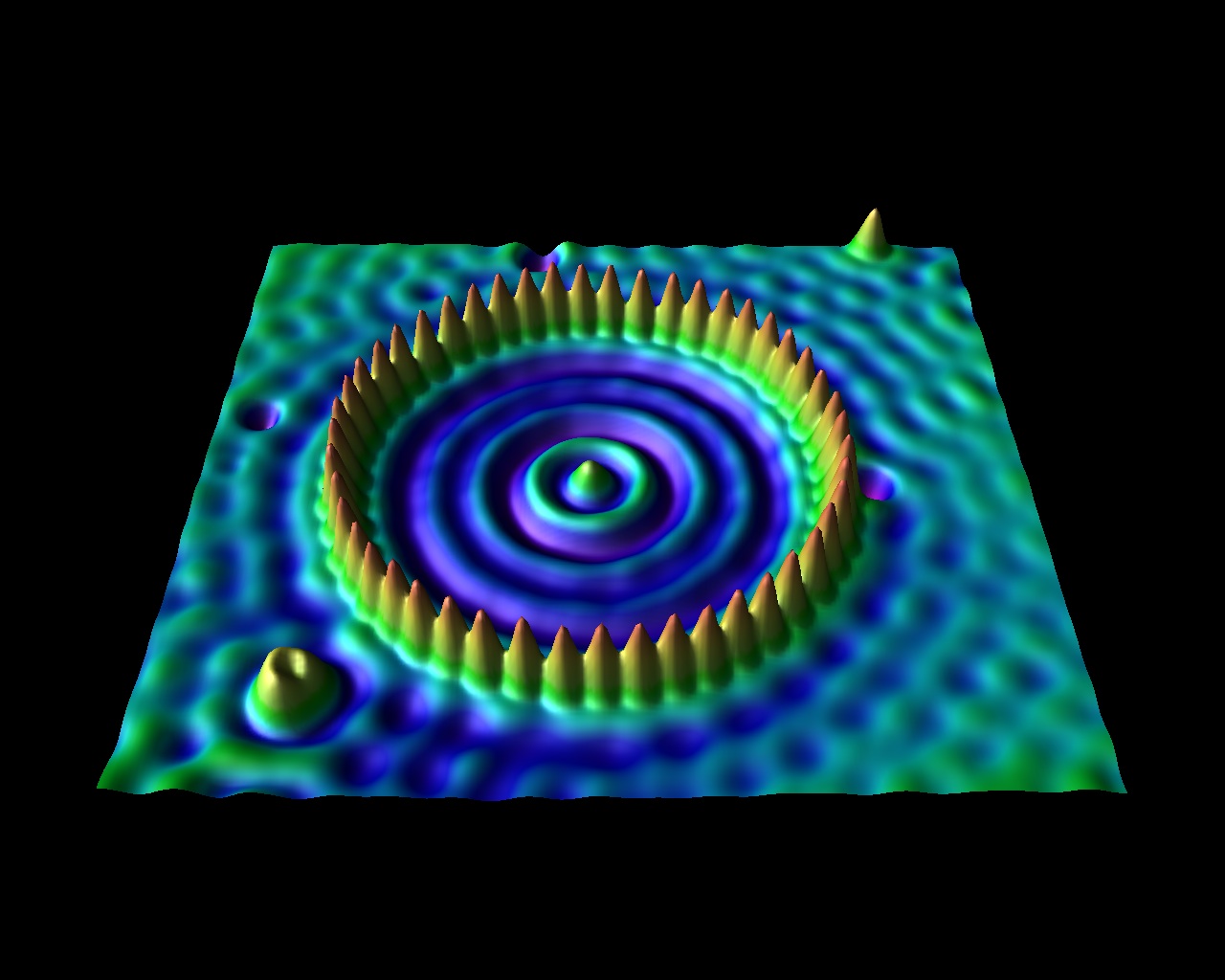
Physics has a long and rich history that has led us down a very weird and windy road. And it is, in large part, directly responsible for modern society. Telephones, much less smartphones, would not be possible without the breakthroughs of understanding electricity or quantum mechanics. It might be baffling to think that your phone works because we know how to manipulate individual atoms. But that's just how far we've come. The image above is just this. Researchers at IBM arranged iron atoms in a circle on a piece of copper and measured it with an electron microscope to reveal that image. It looks like colorful ripples in a pond, but those are actually atoms.
Physics is important for many reasons. It's important because it helps us. It's important because it gives us a deeper understanding of nature. It's important because it helps to show us our place in the universe. And, it's important because like other sciences, it helps us to keep asking questions and be constantly reminded that we don't know everything.
I'll close with a video of one of the greatest physicists of the 20th century, Richard Feynman, and some of his thoughts and insights about physics.