Spaces
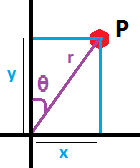
Question: What's the difference between the blue and the purple markings on the image to the right?Distance and Euclidean Space
"Space" is a very vague word. You could mean Outer Space, or the Space key on a keyboard, or somebody might tell you to give them some space. But all of these seem to involve some use of dimensions, of distance, area, or volume.
"Euclidean" space is probably the one you're most familiar with. It's named after the ancint greek mathematician Euclid and it's what you study in K-12 geometry. It involves flat planes, 3D rectangles, triangles who's inner angles add to 180 degrees, and that shortest path between two points is a straight line (there are some spaces where this isn't true). But how, exactly, do you even measure distance?
With the distance formula, which is basically the Pythagorean Theorem. If you have two (x, y) points (call them P1 and P2) then the total distance between them is:
$$ d^2 = (x_2 - x_1)^2 +(y_2 - y_1)^2 $$
or, taking the positive square root of both sides
$$ d = \sqrt{(x_2 - x_1)^2+(y_2 - y_1)^2} $$
To find the total distance you find the square of the distance from P2's X position to P1's X position and add that to the square of how far apart P1's and P2's Y-components are. Take a look at the image to the right where P1 is (0, 0) and P2 is the red point.
Coordinates and Units
You can choose to "measure" a space however you want. You can pick (0, 0) to be at any point and still get the right answers in the end. In the above image, I have drawn two overlapping coordinate systems. The blue system is a rectangular coordinate system and the purple one is a circular (or polar) coordinate system. What's the difference?
Both coordinate systems are describing the same space (the white box with a red dot in it). Both systems are two dimensional because they are flat. Both systems can tell you where the red dot is equally well. The difference is that the rectangular coordinates describe the point as though it were on a rectangle with width x and height y. And the polar coordnates describe the red dot in terms of the length (r) and the angle (θ) of the purple line.
Just as you can choose any coordinate system you want, you can also choose any units you want to describe things as long as you are consistent. Units don't matter as much in math, but they are crucial in the sciences. It's not enough to say "a car is going 100 fast", you have to attach a context. Is that 100 miles/hr, 100 feet/sec, or what?
Abstracting
As I said, "space" is a very vague word. Euclidean space is probably the most common space and the one we have the most intuition for. It's basically our default concept of space. But because "space" is such a vauge notion, it is also a very powerful one. Scientists and mathematicians have invented all sorts of cool spaces like Hilbert Space, Phase Space, a Polynomial Space, and more. All these spaces represent different things. For example, in physics, if a particle is moving then at every point in time it has an (x,y,z) position. This would be the particle's representation in Euclidean space because it's telling you where in the real world it actually is. But the particle's Phase space is different. Instead of measuring (x,y,z) versus time, it measure's the particle's position and momentum, which allows you to describe the particle's energy.
In math, when you take a concept like Euclidean space and expand it, make it more general or make it apply to more than just that initial situation, you are abstracting. You are taking a concept that is true in one realm and sort of bumping it up to apply to many similar things at once.
Drawing sound, an example
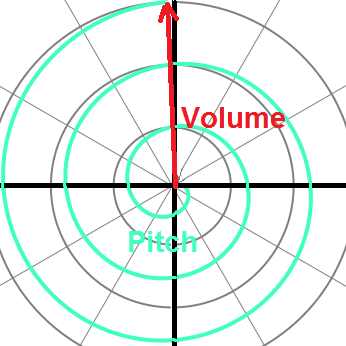
Here I have abstracted a 2D space to represent music. Polar coordinates are used. The clockwise angle represents the pitch, or the note played. And the distance from the origin represents the volume of the note. See the sketch to the right.